
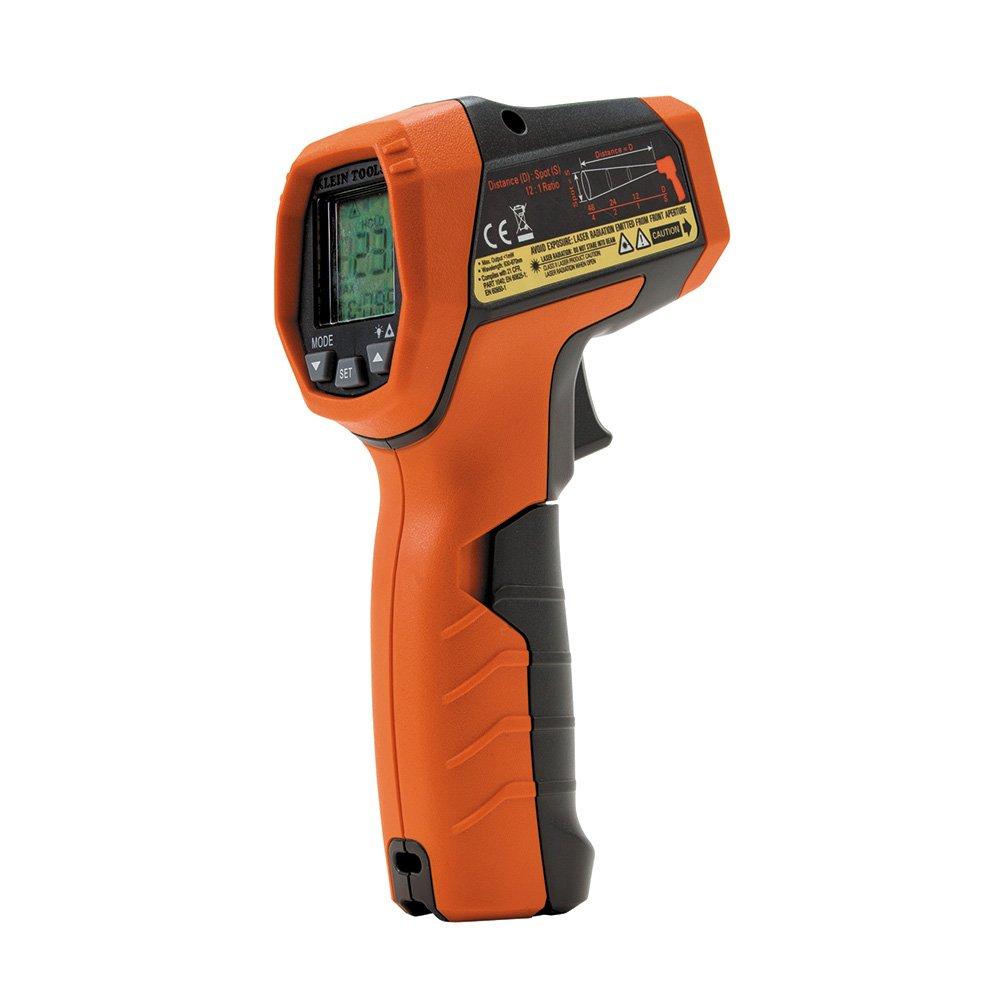
My Real-World Test of the Klein Tools IR5
I’ve been crawling through tight attics, dirty basements, and scorching rooftops for over twenty years, and I can tell you that an infrared thermometer isn’t just another gadget-it’s one of the most critical diagnostic tools in my bag. Whether I’m tracking down refrigerant flow issues across evaporator coils, verifying supply/return temperature splits, or hunting for thermal bridging that’s killing a system’s efficiency, I need accurate readings fast. That’s why I’m putting the Klein Tools IR5 Dual Laser Infrared Thermometer under the microscope today. Klein has built their reputation on tools that survive real jobsite abuse, and this IR5 promises a 12:1 distance-to-spot ratio, dual laser targeting for precise measurement area identification, and a temperature range from -22°F to 752°F-wide enough to cover everything from diagnosing low refrigerant superheat on an R-410A system to checking flame sensor temperatures on a furnace. The adjustable emissivity feature is particularly important when you’re bouncing between shiny copper lines, painted ductwork, and matte black compressor housings throughout the day. I’ve tested this thermometer across multiple service calls and installations, and in this review, I’m breaking down whether the IR5 delivers the accuracy, durability, and practical functionality that working HVAC technicians actually need-or if it’s just another tool that looks good on paper but falls short in the field.
Product Overview: My First Impressions of the Klein Tools IR5

When I first unboxed the Klein IR5, I immediately appreciated the solid build quality you’d expect from a brand that’s been in the trade since 1857. The dual laser targeting system is a standout feature right out of the gate-those two laser dots show you exactly where you’re measuring, with the distance between them approximating the circular measurement area. This is invaluable when I’m checking compressor temperatures, motor windings, or verifying superheat and subcool on refrigerant lines where precision matters. The 12:1 distance-to-spot ratio means I can stand back 12 inches and get an accurate reading from a 1-inch spot, which is tight enough for most HVAC diagnostics without having to jam my hand into tight spaces around capacitors or near hot condensers. The backlit display is clear even in dim attics or crawlspaces, and the unit feels rugged with its 6.6-foot drop protection-a necessity when you’re balancing on a ladder troubleshooting a rooftop unit in July.
| Specification | Details |
|---|---|
| Temperature Range | -22°F to 752°F (-30°C to 400°C) |
| Distance-to-Spot Ratio | 12:1 |
| Emissivity | Adjustable 0.1 to 1.0 |
| Key Features | Dual laser targeting, auto scan, max/min/avg/diff modes, high/low alarm |
| Durability | 6.6 ft. drop protection |
| Included | Custom pouch, batteries |
The adjustable emissivity (0.1 to 1.0) is critical for anyone working with different materials-copper refrigerant lines, aluminum coils, painted metal cabinets, or plastic drain pans all reflect infrared energy differently, and being able to dial in the emissivity ensures I’m getting true surface temps rather than guesswork. The auto scan mode and calculation functions (max/min/avg/diff) let me quickly sweep across evaporator coils to spot uneven refrigerant distribution or identify hot spots on contactors and relays before they fail. The included pouch and batteries mean it’s ready to go right out of the box, which I appreciate when I’m already juggling manifold gauges, a multimeter, and my phone with the service manual pulled up. For checking airflow temperatures at registers, verifying flame rollout on furnaces, or diagnosing compressor overheating on R-410A systems, this thermometer covers the temperature range I encounter daily without the bulk or cost of a thermal imaging camera.
Dual Laser Targeting System and Temperature Accuracy in Real World Applications

The dual laser targeting system on this Klein thermometer is one of those features that sounds gimmicky until you actually use it in the field, and then you wonder how you ever worked without it. The two laser dots provide a visual boundary that shows you the approximate diameter of the measurement area you’re reading-critical when you’re checking superheat on a suction line or verifying evaporator coil temperatures on a split system. I’ve used this extensively on both R-410A and R-32 systems, and the 12:1 distance-to-spot ratio means I can stand back about a foot and get accurate readings on components without risking contact with live electrical connections or hot surfaces. The adjustable emissivity from 0.1 to 1.0 is essential for getting true readings on different surfaces-I typically run it at 0.95 for painted metal surfaces like condenser cabinets, but dial it down to around 0.3 when measuring shiny copper refrigerant lines. The temperature range of -22°F to 752°F covers everything from checking supply air temperatures on high-efficiency variable-speed air handlers to verifying heat strip output on electric furnaces running at 10-15 kW.
In real-world diagnostic scenarios, the accuracy has been spot-on when cross-referenced against my contact probes. I’ve used it to quickly scan ductwork for hot spots indicating poor insulation or air leaks that kill SEER ratings, check compressor shell temperatures to verify proper refrigerant charge, and monitor condenser coil temperatures during cleaning to ensure proper heat rejection. The auto scan mode with max/min/avg/diff calculations is invaluable when you’re walking a large commercial rooftop unit and need to identify temperature differentials across the coil-anything more than a 10-15°F variance often indicates airflow issues or refrigerant distribution problems. The backlit display is bright enough to read in direct sunlight on a roof, and I’ve dropped this thing more times than I care to admit off ladders and equipment platforms without issue thanks to the 6.6-foot drop protection. For HVAC diagnostics where split-second temperature readings can mean the difference between a quick fix and hours of troubleshooting, this tool has earned a permanent spot in my service bag.
| Feature | Specification | Field Application |
|---|---|---|
| Distance-to-Spot Ratio | 12:1 | Accurate readings from 12 inches away on 1-inch targets (refrigerant lines, electrical connections) |
| Temperature Range | -22°F to 752°F | Covers evaporator coils, supply air, heat strips, and compressor diagnostics |
| Emissivity Adjustment | 0.1 to 1.0 | Compensates for copper lines (0.3), painted metal (0.95), and various surface materials |
| Dual Laser Targeting | Visual measurement area | Shows exact spot size for precision on small components and refrigerant lines |
| Drop Protection | 6.6 feet (2 meters) | Survives typical jobsite drops from ladders and equipment platforms |
Backlit Display Performance During Field Work

The backlit display on this Klein thermometer has proven invaluable during those late-night service calls and cramped attic inspections where lighting is practically non-existent. I’ve found myself checking superheat and subcool temperatures on R-410A systems in mechanical rooms with zero ambient light, and the display remains crisp and easily readable without needing a flashlight. The backlighting activates automatically and provides excellent contrast whether I’m verifying compressor discharge temperatures on a 3-ton split system or scanning evaporator coil surfaces during a low-airflow diagnosis. The display shows current readings along with max/min/avg values simultaneously, which is particularly useful when monitoring condenser coil temperatures during peak afternoon loads or tracking temperature differentials across heat exchangers on high-efficiency furnaces.
What sets this unit apart during field diagnostics is how the backlit screen maintains visibility even in direct sunlight-a common issue when working on rooftop units or outdoor condensers. I’ve used it extensively for electrical component checks, measuring breaker temperatures on 240V circuits feeding 18 SEER mini-splits, and it handles the transition from bright outdoor conditions to dark utility closets without any readability loss. The auto power-off feature preserves battery life during those marathon installation days, and I appreciate that the display stays lit long enough to record measurements when documenting pre-installation conditions or verifying proper refrigerant line temperatures on TXV-equipped systems. The combination of dual laser targeting and the backlit readout makes it simple to confirm that I’m measuring the exact spot on a compressor housing or liquid line that matters for accurate diagnostics.
| Display Feature | Field Application | Practical Benefit |
|---|---|---|
| Backlit LCD | Low-light mechanical rooms, attics, crawlspaces | No flashlight needed during diagnostics |
| Sunlight Readability | Rooftop condenser service, outdoor installs | Clear readings in direct sunlight |
| Multi-value Display | Temperature monitoring across coils/heat exchangers | Track max/min/avg without manual logging |
| Auto Power-off | Extended service calls, multi-unit installations | Maximizes battery life in the field |
Auto Scan Function and Practical Applications for HVAC Diagnostics

The auto scan function transforms how I approach diagnostic work on residential and light commercial systems. When I’m troubleshooting a 410A system with suspected refrigerant issues or checking for temperature inconsistencies across evaporator coils, holding down the trigger activates continuous scanning that updates readings in real time. This feature proves invaluable when tracking supply versus return air temperatures across a 3-ton unit-I can sweep across diffusers and registers while watching the display automatically capture max, min, and average temps without releasing the trigger. During compressor diagnostics, I’ve used auto scan to monitor discharge line temperatures on systems ranging from 18,000 to 48,000 BTU, catching intermittent thermal fluctuations that would be missed with single-spot readings. The differential calculation mode has saved me considerable time when verifying temperature splits on heat pump installations, particularly on high-efficiency units where maintaining proper superheat and subcooling is critical to achieving rated SEER values above 16.
In practical field applications, I rely on this tool daily for checking electrical panel temperatures during high-amp startup cycles on 240V condensers, identifying hot spots on blower motor housings that might indicate bearing failure, and verifying condenser coil surface temps to assess airflow restrictions from debris buildup. The dual laser targeting with 12:1 distance-to-spot ratio means I can safely measure compressor shell temperatures from 12 inches away, avoiding contact with energized components on units drawing 20-30 amps. I’ve found the adjustable emissivity particularly useful when scanning refrigerant lines-setting it to 0.95 for oxidized copper versus 0.3 for polished copper gives me accurate readings whether I’m checking suction line temps on a newly installed system or an older unit with weathered linesets. The high/low alarm feature helps me quickly identify zones with inadequate airflow in multi-zone systems, flagging supply registers that deviate more than 10 degrees from target temperatures.
| Diagnostic Application | Typical Temperature Range | What It Reveals |
|---|---|---|
| Evaporator Coil Surface | 40-55°F | Refrigerant flow, airflow restrictions |
| Compressor Discharge Line | 150-220°F | Compression efficiency, refrigerant charge |
| Blower Motor Housing | 100-140°F | Bearing condition, electrical issues |
| Supply Air Temperature | 55-65°F (cooling) | System capacity, proper operation |
| Electrical Panel Connections | Ambient to 120°F | Loose connections, overloaded circuits |
Transform Your World
## The Bottom Line from the Field
After putting the Klein Tools IR5 through its paces on real HVAC calls, I can tell you this: it’s earned its spot in my toolkit. In my 20+ years turning wrenches and chasing temperature differentials, I’ve learned that the tools you carry either make your day easier or cost you time-and in this business, time is money.
This thermometer does what Klein has always done best: it shows up ready to work. The dual lasers aren’t a gimmick-they’re genuinely helpful when you’re squinting at a compressor in a cramped mechanical room or checking supply temps in a dark attic. The 12:1 ratio gives you accurate readings without having to climb into tight spaces, and that wide temperature range means you’re not switching between tools for different applications.
Here’s what I want you to understand: accurate temperature measurement isn’t just about diagnosing problems faster. It’s about catching issues before they cascade into expensive failures. It’s about verifying that systems are running efficiently, which directly impacts your customers’ energy bills. It’s about ensuring proper refrigerant charge, balanced airflow, and optimal heat transfer-all the invisible factors that determine whether a home stays comfortable year-round or becomes a service callback waiting to happen.
The Klein IR5 gives you the confidence to make those calls correctly. When you’re standing in front of a homeowner explaining what’s wrong with their system, you need tools you can trust. Klein’s been building that trust since 1857, and this thermometer continues that tradition.
Whether you’re a fellow tech looking to upgrade your diagnostic arsenal or a serious DIYer who wants professional-grade accuracy, the IR5 delivers. It’s durable enough for daily jobsite abuse, accurate enough for critical measurements, and priced reasonably for what you’re getting.
Don’t settle for guesswork when precision is available. Make the investment in proper diagnostic equipment-your reputation depends on it.

Thank you for your review, it was very informative, I’ll purchase one for DIY use on my HVAC system.
Hi Tim! I’m glad to hear you found the review informative. The Klein Tools IR5 is a great choice for DIY HVAC projects, and I’m sure you’ll appreciate its performance and accuracy. If you have any questions while using it, feel free to reach out. Happy DIYing!